
I find that the fascination with which the Tarot holds me is deeply similar to that of ballet. I didn’t always realize or understand that connection but it just occurred to me this morning. I was asking myself “Why do you prefer the Tarot to oracle cards?” I wanted to reach within to see why I seem to view oracle cards with a slight suspicion and why I seem to hold such reverence for the Tarot. It’s not that I don’t value oracle cards (I do own several decks), but why do I seem to draw such strength from the Tarot? Why are they my “go-to” when I want to make sense of either my inner or outer worlds?
First of all, part of the answer lies in the fact that the Tarot, like ballet, is a fixed system. There are rules, there are numbered images, there is a set vocabulary of meanings and movements, and both systems emerged not from the brain of one individual, but actually arose from the collective experiences, contributions, and adaptations of multiple generations. In both arts there is a reverence for tradition and yet also a built-in subjectivity. You’re allowed to bend or break the rules to suit your own needs of expression, but it is the structure of those roles (even bent or broken) that provide the meaning. I find the structure reassuring and yet I take delightful exhilaration in manipulating that structure to conform to my own needs.
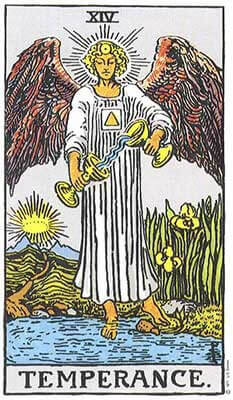
The Temperance card reminds us of the virtues of “mixing well.” Not necessarily finding a balance, because that implies that there is some predetermined and static medium that we are trying to reach. That’s not what Temperance is about. Temperance is about taking two distinct essences, perhaps even two opposing forces, and mixing them “well” such that the result offers the unique power you intended you bring into existence. Both ballet and the Tarot seem—at least to me—to be a well mix of structure and subjectivity, of the familiar and the novel, of tradition and transcendence, of the established and the ever-evolving. In both, the established vocabularies—indeed the catalogue of images—serve to expand our potentiality of expression and understanding, rather than to limit it. That structure brings our potential to move, to share, and to invite new experiences, sensations, and insights more directly to us.
Ballet and the Tarot free us from the limitations of being ourselves. By being asked to conform and yet simultaneously to create, we are put in a powerful and transformative dialectical relationship with something outside of ourselves. We needn’t draw merely from within and produce an entirely new creation—no, we are liberated from that pressure. Rather, we take in what that external and established system offers us, and in making sense of it, perhaps even processing it externally with our outward rendering (in performance or in reading for someone else), we offer the world something uniquely transformative. And we find ourselves changed in the process as the forces within us encounter, resist, snuggle against, and merge with those which are outside ourselves until we can no longer tell the difference. What originated with me and what originated hundreds of years ago? In blurring those boundaries, we find ourselves connected to the world in profound ways. Indeed, we are co-creating with the universe, constructing a new understanding of our realities.
In a delightfully confusing way, every action we take is rendered refreshingly anew, and yet in another sense, we ask ourselves, “is anything really ever new?”
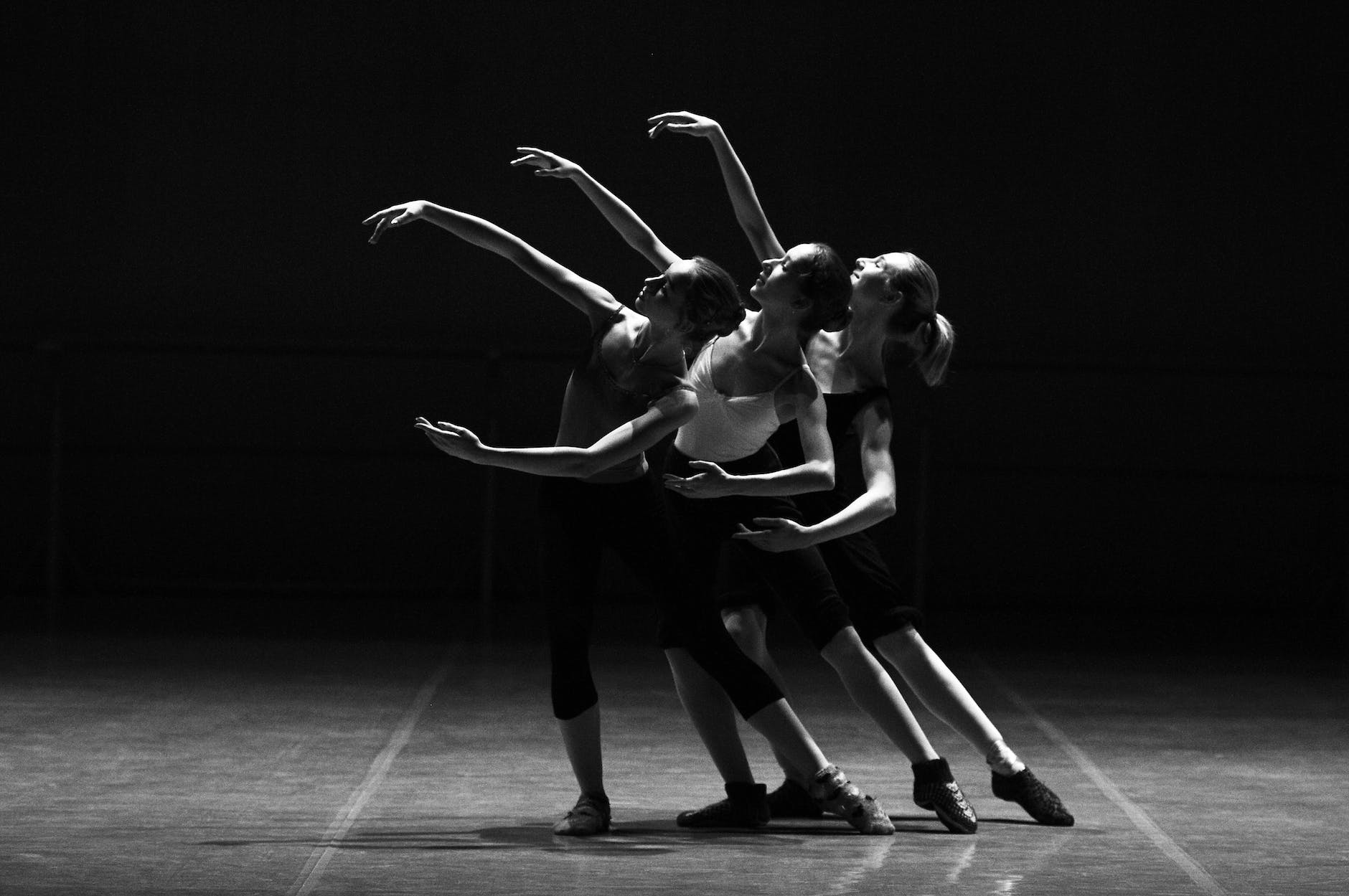
The dancer can take the five numbered positions and the seven basic movements and create varied combinations. The dancer can take a classical virtuoso step, recognizable to the world, such as a tour jeté. They can execute it with precise adherence to the accepted conventions, and yet somehow manage to present it with unique “soft” qualities—it’s a convention imbued with feelings that powerfully affect the audience, who recognize that they have seen something new within something familiar.
Likewise, the Tarot reader can come across a card, let’s say Key XV: The Devil. Like ballet, the Tarot consists of numbered structure and an inventory of recognizable images. There is of course a standard interpretation, but the artistry of the system allows for subjective interpretation and the piecing together of new narratives with old elements. The result is that the querent–just like the audience at the ballet–is offered an individualized experience.
It’s not the what that matters, but rather the how.
It is in the interaction between the internal and the external, between the old and the new, between convention and chaos, that we find our realities and our selves.
This is why I find ballet and the Tarot to be fundamentally akin and why I find myself so enigmatically and profoundly drawn to each.
It is in the interaction between the internal and the external, between the old and the new, between convention and chaos, that we find our realities and our selves.
 Jesse's Journey: Reading the Tarot, Living the Life
Leave a comment