
The original title for this blog was “What Tarot Taught Me,” but in writing it, it quickly became apparent that the Tarot is not through teaching me anything. All of the powerful lessons below deserve to remain thought of in the present tense. These lessons here, and their importance in my life, continue to unfold. I hope that that’s the case for you, as well.
How To Teach Oneself Anything
In the dance world, which I also inhabit, if you were to ask anyone how they learned to dance, they would almost certainly give you the name of a specific teacher. We dancers are very aware of where and how we studied dance and it was under the tutelage of a specific person, or at the very least, within a specific studio. In the Tarot community, though, it seems that the opposite is almost always true. By far, most readers taught themselves. For many, this was a matter of necessity. Studying the Tarot can be quite a solitary practice complicated by moral or religious taboos or limited by a lack of those with a mutual interest. But regardless, endeavoring to teach oneself something–anything!–becomes a series of lessons in the art of learning itself. Teaching myself the Tarot, which itself remains an infinite task, taught me how to teach myself how to do anything.
Teaching myself the Tarot, which itself remains an infinite task, taught me how to teach myself how to do anything.
How does one teach oneself anything? By taking an interest, committing one’s intention, and following one’s intuition. (You’ll notice that I have a “thing” for alliteration in all of my teaching!) Not only is “interest” one of Barbara Fredrickson’s ten positive emotions (see her book Positivity), but when we take an interest in something, we very naturally begin the learning process by posing questions for which we would really like to find the answer.
This is where intention comes in. The more you learn, the more accurate, specific, and powerful your intentions become. If your question is “What is the Tarot?” or, “What makes a Tarot deck distinct from ordinary playing cards?” your intention may be just to satisfy your passing curiosity. But if the more you learn and the more questions you find yourself asking, you may reach a point at which you never run out of questions and you’re always yearning for bigger and better (or at least different) answers! It is then that you’ve likely discovered that your interest has become something of an effortless commitment. You’ve set your intention of mastering something new! It’s often described as a “calling”–because it feels not as though you sought it out, but it actually had been seeking you.
The thing about allowing yourself to notice what questions pop into your mind–especially the ones that don’t go away and tend to resurface again and again until they get the attention they’re demanding–is that that is a great way to be effortlessly guided by the greatest teacher any of us could have: our own intuition. Let the answer to every question you pose suddenly become a rabbit-hole down in which you find thousands of new questions. Keep asking, keep searching, and you will find yourself in the process of mastering.
Tarot is like language. It is very much indeed its own language. How did we, as children, learn to comprehend, speak, and articulate our thoughts in language? No one gave us a guidebook as infants, divided into neat chapters like “Chapter 1: Nouns” in order to develop language. Rather, you just start using it! You pick up a word here or there. Young humans are driven by an insatiable curiosity; they are amazingly equipped to be intuitive learners. And what is an effective way for a young person to engage with the fascinating world around them? They PLAY!
It’s okay for you to play with your Tarot cards! Lay out a reading for yourself and start looking up the meanings in a trusted guidebook or, better yet, in multiple books. You will find that some books have differing or even contradictory meanings. That’s okay! Don’t be confused or overwhelmed! This isn’t a vocabulary test that you’re studying for! Just play! The thing about play is that it’s supposed to be fun! Read for yourself, read for close friends who understand you’re starting out. Give yourself a chance to decipher the meanings from the images on the card (“what is the story that this card is telling?”) and then look up the meaning in another resource.
Before you know it, you will be intimately familiar with each of the cards as if they were old friends. No rote memorization needed. Having a “feel” for each card can be more powerful than having memorized keywords. Knowledge gets embedded in our brains when it’s repeated and found useful. Giving readings to people you know will accomplish both for you!
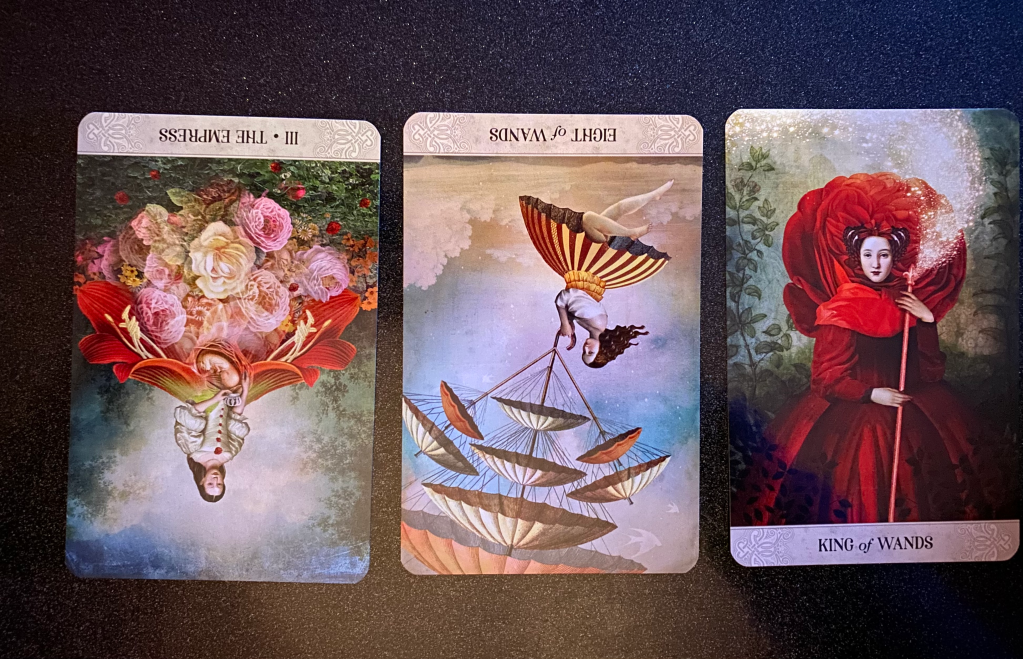
(Tarot of Mystical Moments)
As you learn the range of meanings that other people have derived from their own personal relationship with the cards, you will come to develop your own personal and nuanced meanings. Eventually you will learn that every card has ingrained within it a vast spectrum of possible shades of meaning. And every time you see any card in particular, it is going to strike you in yet another unique way. This sense of perpetual uniqueness is what makes the Tarot such a subjective and rewarding art.
How to Learn a Truly Subjective, Intuitive Art
I believe that the Tarot is like any other art. Once you get a sense of the established “rules” and conventional practices, you begin to discover your own style by gaining the confidence to use those established techniques for your own intention. In dance, for instance, we may learn the strict rules of ballet because that’s all we’re given to work with. But then, the urge to express oneself, to explore, and to make sense of our reality takes over and we find that our technical training serves us, rather than the other way around.
No two readers will ever read the cards the same way, even if they draw the same cards, in the same positions, of the same spread, for the same person. We all bring our own unique experiences, sensibilities, and instincts to our encounters with the cards. That is what makes the Tarot such a subjective art. The cards don’t speak on their own; they require a human interpreter. But I firmly believe that the magical combination of an external prompt (like the cards) with an internal subjective encounter (through the intuition of the reader) leads to a truly beautiful, brilliant, and transcendent message. The Tarot never gives bad advice.
Like with any intuitive or subjective art that absolutely cannot be reduced to rational, objective, and clearly-defined rules, we need to not only develop our intuition itself, but our confidence in that intuition. This will only come with practice, with experience giving readings for real-life human beings with a real-life stake in what you’re going to offer them. If that sounds intimidating to you, then remember to think about the experience in terms of play! Play should be fun! Then, as your confidence builds from those positive experiences, you may find yourself with increasing willingness to take on querents with more serious questions or querents you don’t know as well. Your evolution will happen before you even realize it! That’s one of the amazing things about human learning that the Tarot taught me! Just do it! Start doing before you feel ready! That lesson applies to the Tarot, to dance, to everything!
Your evolution will happen before you even realize it! That’s one of the amazing things about human learning that the Tarot taught me! Just do it! Start doing before you feel ready! That lesson applies to the Tarot, to dance, to everything!
The Vocabulary of the Human Experience
Despite everything I said about the value and magic of subjectivity, when we can learn to view life’s situations with some degree of objectivity, life can begin to feel more understandable and more manageable. Just as having the faculty of language can make abstract concepts more “real” (if we can talk about them, we can do something about them!), the Tarot provides an amazingly versatile and limitless vocabulary for understanding the human experience.
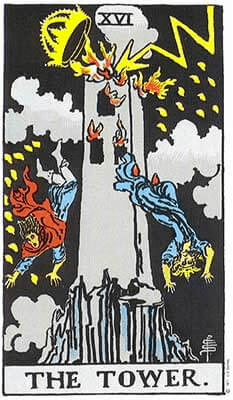
Every Tarot reader I know has the particular habit of seeing their real life in Tarot terms! “This was a real-life ‘Tower’ moment!” “It was a ‘Nine of Swords’ kind of night last night!” “Oh no! You’re that creepy guy in the ‘Seven of Swords!’” When we see these translations between the scenes abstracted in the cards and our own real-life specific situations, we are reminded that we are not alone, and others have come before us. Others have grappled with the same emotions, navigated the same situations, and interacted with the same kinds of people. As a system, the Tarot has evolved over the centuries and that is what can make it such a wise and insightful “friend.” It has been there before. It truly has the wisdom of the ages to help us weather our own times. We are not alone. And the Tarot can remind us of that and offer us the chance to connect meaningfully with each other, with the cosmos, and with our inner selves.
I hope you continue with your Tarot journey and never hesitate to reach out!
 Jesse's Journey: Reading the Tarot, Living the Life
Leave a comment