
Knowing I wanted to write an essay today, I couldn’t decide whether it should be for my blog on creativity (I’m also a creativity consultant) or on the Tarot. Whenever I have a decision to make or find myself in need of inspiration, I turn to one of my trusted creativity tactics I call the “drop-and-distract.” I set everything down and distract myself with something completely different that will absorb my conscious mind and allow my unconscious, which I am convinced the more creatively brilliant mind, to synthesize a promising new direction.
I posed the question to myself to better invite invite a clear answer: “creativity or Tarot?” Then, I turned on a random episode of a random season of The Simpsons, which is always an enjoyable distraction. Just a couple minutes into the episode, we see the Simpsons visit a fortune teller, who has—you guessed it!—Tarot cards sitting on the table in front of her. When Homer accidentally catches himself on fire with one of the fortune teller’s candles and then ruins her shop by setting off the sprinkler system, she exclaims, “I should have seen this coming!” We then see two of the cards that had been laid out on the table. No, we don’t see The Magician or the Ace of Cups; we see “The Flaming Jerk” and “The Ruined Gypsy.”

I laughed so hard! I thought the scene was cute and clever and I wanted to celebrate the creativity of the writers and animators. That’s when it occurred to me: the topic for this essay should not require a choice between the Tarot and creativity. This episode clarified for me that the answer was both—I was to write on both the Tarot and creativity.

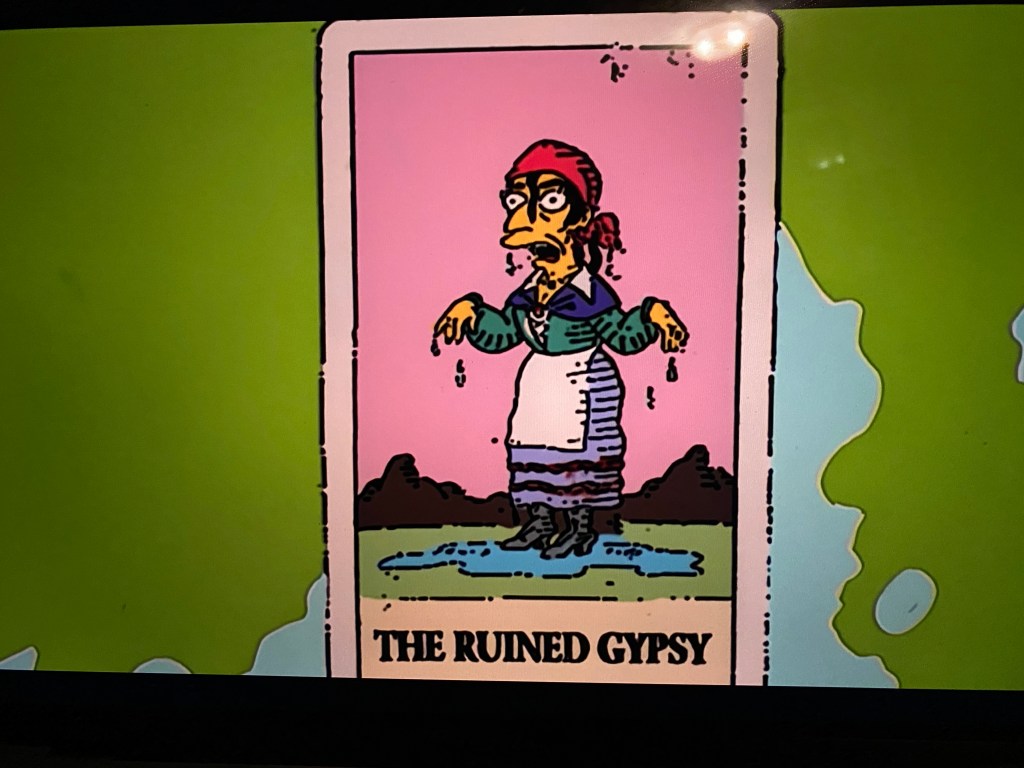
When my laughter at the scene subsided, I realized that a profound synchronicity had occurred. The legendary psychologist Carl Jung developed the concept of synchronicity, which he defined as “meaningful coincidence.” In today’s mainstream parlance, we might think of them as “signs.” We all know people who are on the lookout for signs. You know, like when you’re thinking about someone and they suddenly call you or when a song gets stuck in your head and then it comes on the radio. These are synchronicities, especially if that coincidence impacts you in some way, bearing meaning. Synchronicities reveal some sort of connection between your internal thoughts and the external, physical world. For me, I experienced a significant synchronicity watching The Simpsons because I had posed a question in my mind, “Tarot or creativity?” and then, when I used my drop-and-distract tactic, I saw, just a few minutes later, a hysterically creative scene featuring Tarot cards. The universe heard my thoughts and responded with a clear and eerily appropriate answer. I was to write about both and, furthermore, there was no way that synchronicity could not play a role in this essay as well.
My drop-and-distract tool works the same way the Tarot works, actually. Pose a question to invite the answer and then perish any attempt to answer ourselves. We entrust the question to the care of the universe and tacitly agree to accept the answer. We place our faith in the power of randomness—whether the randomness of a silly but creative TV show, or the randomness of a well-shuffled deck of Tarot cards. Regardless, we surrender our control and let the chips fall where they may (pun totally intended; randomness is the hinge around which both divination and gambling revolve).
Both “drop-and-distract” and the Tarot rely on synchronicity to provide their insights. We ponder a question internally and then the external world manifests an appropriate answer. Tarot readers often talk of “stalker cards”— cards that, despite thorough shuffling, seem to always appear, bluntly reminding us that neither our circumstances nor the answer have changed. We see it also when the theme of a card seems to directly address the nature of the querent’s question. A question about motherhood brings up The Empress. Or it occurs when a question about money brings up a number of pentacles cards—a disproportionate number, it seems, than could be possible through the laws of chance alone. But it makes sense to us: synchronicity is at play.
It makes sense then that the Tarot can be a powerful tool for creativity. I may have a gig coming up where I’ve been hired to teach a creativity seminar, which I love doing, and, if I need a fresh idea, I may ask the cards: “What does this audience need to hear?” I draw a few cards, usually three, and when I synthesize a coherent message from that draw, I am so often struck by the relevance and profound insights offered by the cards. Tell the audience, “Dream big but don’t neglect the small tasks in front of them; monumental accomplishments come through mundane tasks,” the cards once said. That was the perfect lesson for that particular audience—and myself—that day. “Don’t get lost in stormy and volatile emotions,” the cards once warned. “Use the intellect to set the course but then trust your intuition,” they advised. I needed that advice and I shared it in my next class.
“That’s simply a case of your own ideas being imposed upon the cards,” a skeptic may claim. I can see that. Perhaps there’s validity to that claim. Maybe unconsciously I read my own instincts “into” the cards. Reasonable. But ya know what? I would never, not in a million years, have been able to dream up those insights consciously. It was the symbols and stories contained in the cards that brought those wise and useful ideas to the surface. The cards work. The cards know. I have other examples of extraordinary and utterly preternatural synchronicities presented by the cards, but I’ll share those in another essay.
It was the symbols and stories contained in the cards that brought those wise and useful ideas to the surface. The cards work. The cards know.
Maybe it’s sheer coincidence that I had a Tarot-related question and then I turned on that episode of The Simpsons. But—and I ask this quite literally—what are the chances? Regardless of how the answers arrive, I just know that they do. We pose the right question, invite the universe to supply the answer, and then place our total faith in the randomness. When we imbue certainty into the most extremely uncertain, the universe has a chance to respond. And we realize that both our inner-most self and the grandest of external realities are, in fact, connected in profound ways that transcend our understandings of probability, chance, and coincidence.
Wherever they come from, the answers appear the moment we invite them.
 Jesse's Journey: Reading the Tarot, Living the Life
Leave a comment