
You may have read a previous post where I spoke about my practice of the Daily Draw (see the post here). I’m proud to say that I have continued that practice, although, at some point, I intuitively began drawing three cards. I’m not sure why, but it felt like the right thing to do in a particular moment and it has every day since. There’s something about “three” that I felt ready to manage. And something about “three” felt right in gaining a clear, coherent narrative. This intuitive shift also highlights one of the most fundamental, and, I think, reassuring aspects of the Tarot’s magic: that you don’t need a “good” reason to do anything. You can be open to intuitive and mysterious sensations that shift even long-held habits.
One day I felt like shuffling the cards differently despite years of a habitual, deeply ingrained method. And I think all experienced readers have felt, on occasion, the peculiar feeling of being drawn to a particular symbol within a card rather than the image as a whole. The lobster (or crayfish) depicted on The Moon, for instance, may capture our attention for “no good reason” during a particular reading. The subtle power of such shifts should never be ignored. The intuition’s energy flows where it wants to and that’s ultimately where it will end up despite any resistance we may initially offer. So, best not to resist.
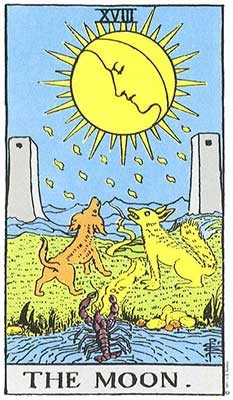
The cards teach us the magic and majesty of our own intuition. Sometimes we struggle with following our intuition or accepting it as valid. In resisting, we actually refuse the call of our inner divinity. Too often, we spend our lives inadvertently practicing or even embracing self-doubt. We unconsciously internalize decades of messages from the outside world telling us that we are flawed or that we have little or nothing of worth to contribute. I’m betting that everyone reading this can empathize with the feelings of inadequacy that such a belief can engender.
The Tarot represents a perfect transitional tool for dealing with such feelings. The harsh cruelties we have encountered in the world may have stunted our ability to see the awesome wonder within ourselves, but we can still encounter that feeling of awe when projected onto the cards. Sometimes, we need an external object—and something as beautiful as a deck of Tarot cards is ideal—in which to see beauty and wisdom and whatever the two of them can synthesize together.
Sometimes, we need an external object—and something as beautiful as a deck of Tarot cards is ideal—in which to see beauty and wisdom and whatever the two of them can synthesize together.
When I do my Daily Draw early each morning, I ask, “What do I need to hear today?” Sometimes I ask, “What do I need to do today?” I intuitively seem to know if it’s a “knowing” or a “doing” kind of day. And the cards always reveal an answer. Often I take a photo of those three cards, bearing such majesty as they lie on the table. They never seem to be laying there inertly. Rather, they seem to be standing with regal dignity—a central card flanked by two others. Indeed, they testify to the innate dignity and power of “three.” The cards remind one of the magically transformative experience of any other rarefied and empowered inanimate sight—we can think of the Pyramids, the Mona Lisa on her own wall in the Louvre, The Sphinx Gate from The Neverending Story. All of these stand still within their own dignity, value, and ability to inspire awe. Movement is unnecessary to be moving to the viewer. Their very existence is their performance.
And so the cards, with their message that I glean through my thought and journaling, serve as a solid, steadfast visual reminder of how I’m being asked to embrace and trust my intuitive shifts. Being asked to think new thoughts, try out new behaviors, and to meditate upon new transformations, is, no matter how pressing or gentle, an assault to what is familiar to us.
But that discomfort that accompanies growth can be assuaged with the reassurances provided by the subtle and yet grand power of the cards’ majesty. On a hectic day, I can look back in my mind’s eye and remember those cards of the morning. I recall them lying there, yet bearing witness to the innermost workings of my psyche and offering the most perfectly exact message.
I listen because they bear that dignity, the self-assuredness of a sage with nothing to prove. The permanence of a treasured artifact that “knows” it is not going anywhere for centuries and centuries. The majestic message of the cards provides an even more magical insight: they teach me, little by little, to glimpse more and more, that majesty within myself. After all, that timeless meaning rendered on/with/from the cards bears a relationship to me. And I can come to believe that my recognition of the innate majesty and dignity of these objects is actually a reflection of my own. And every human deserves and needs that experience.
 Jesse's Journey: Reading the Tarot, Living the Life
Leave a comment