
Hello dearest Tarot readers! Although for the past few months, it felt as though I were writing blog posts and then sending them out into the void, I’m starting to see some likes and new followers, which is incredibly heartwarming to me! Please feel free to comment, ask questions, or suggest new topics that you might like me to take on. I would so appreciate it! My vision is to create a very warm community driven by both passion and curiosity for the Tarot and how it can positively impact our lives. Thank you for helping me build that!
“Confabulation” is the name given to the brain’s ability to fill in missing information by creating an overall story that makes sense given the information actually available. The etymology of the word refers to “putting together a story (fable).” While in psychological and neuroscientific settings, “confabulation” generally carries a connotation of untruth or imagination, we actually confabulate narratives all the time. For example, if you’re at all like me, and you miss an unexpected phone call from an important person, your brain can create all kinds of horrifying scenarios before you learn that it was actually an accidental call.
As human beings, our brains are quite good at spinning entire narratives given only partial information and this precise ability is crucial in interpreting the Tarot for two significant reasons. First, the Tarot can only ever give us a partial picture. The system itself is limited to those 78 cards and their placement in a given spread. We need to be able to construct the connective tissue that brings together the cards appearing before us into a narrative that also connects to the question or situation at hand. That leaves many gaps to be filled in. Secondly, by relying on our own mental processes, some of which are unconscious, confabulating the narrative offers a chance for intuitive meanings to bubble to the surface. Our intuitive knowledge, whether it comes from latent thoughts, unconscious mental machinations, or even the psychic realm, needs an outlet through which it can come to be known. Confabulating a narrative with the cards that appear allows a reader to do just that.
Our intuitive knowledge, whether it comes from latent thoughts, unconscious mental machinations, or even the psychic realm, needs an outlet through which it can come to be known. Confabulating a narrative with the cards that appear allows a reader to do just that.
By “confabulation,” I do not mean to suggest that we “make things up” or rely on our creative capacities to produce fictions. We aren’t creating the story, rather we are drawing upon our subjective knowledge and intuitive hunches to bring the elements of the reading together in a way that makes sense and can best answer the question or concern of the querent.
Here are some of the elements a Tarot reader must work with in rendering a coherent confabulation that can best speak to the individual for whom we are reading:
- The traditional meaning of each card
- Any symbols or depictions on each card that seem to intuitively speak to us
- How the cards’ meanings are indicated, affected, or altered by their placement in the given spread or their proximity to each other. Sometimes I even lay out the cards without a meaningful spread and then confabulate the narrative in the way that intuitively makes sense. Some of my most accurate readings have come about that way!
- How the cards, given the three previous points, can fit together into a story
- How that story the cards seem to be indicating can address the querent’s question or area of concern
I’d like to give you an example of confabulation by sharing the reading I did for myself this morning!
Every morning I draw two or three cards as part of my morning practice (please see this previous post: A Deeply Rewarding Tarot Practice: The Daily Duo Draw!) and then journal about them. Sometimes I ask a specific question and sometimes I leave it open for a general reading. Since recently I’ve found myself being drawn to the idea of writing a book, I asked what I should write about and drew the following three cards.
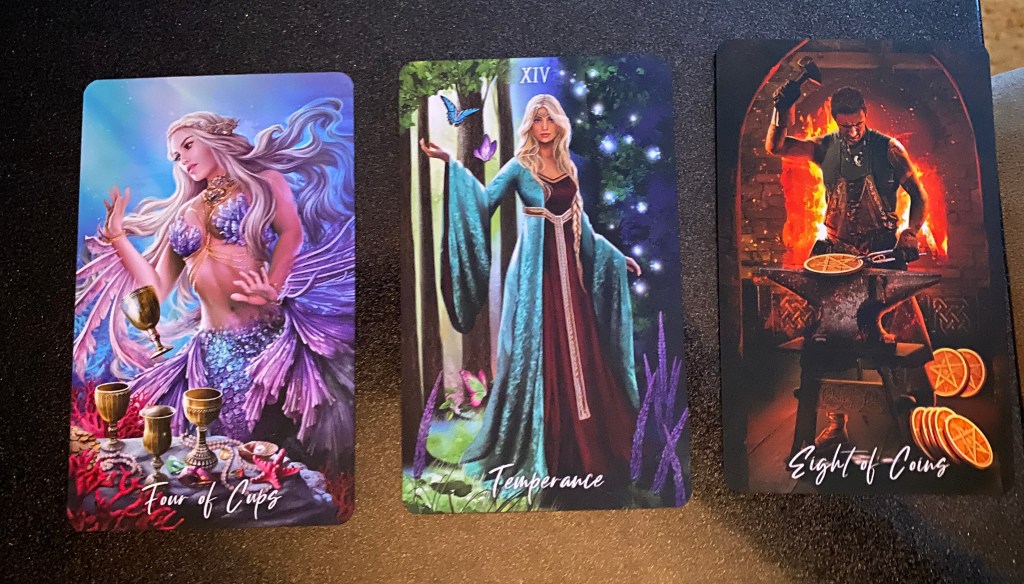
Let me take you through the steps of interpretation that I seem to always follow:
- Be overwhelmed and confused. Ha ha. Don’t we always feel this way when we look at the layout before us?
- Notice any overarching pattern that strikes you. For instance, I noticed that these are all upright cards. I DO read reversals and shuffle to get both reversed and upright cards, so the fact that all three are upright makes it feel as though the cards have a direct and deliberate message to give me. Such overarching patterns can reassure us that our question has been heard and the cards are giving us an intentional answer that can’t be explained away by randomness alone.
- Review the traditional meanings or “key words” of each card to give yourself a starting point to create a narrative.
- FOUR OF CUPS: Being unaware of a gift being presented, overlooking something potentially positive
- TEMPERANCE: Mixing well, actively establishing or finding balance, blending ingredients to synthesize something new
- EIGHT OF CUPS: Work on a material level, labor, industry, a skilled career
- Determine by intuition to whom or what the cards seem to be speaking. I noticed that these are three prominent solo figures and for no good reason (be sure to notice whenever this phrase pops up in your head because that’s a clear indication that you are accessing your intuitive faculties!), I felt that they were depicting not me, myself, but my audience. The cards were indicating what I should teach my audience through my writing.
- Ask how these cards, given their traditional meanings, can fit together in a way that does justice both to the cards as they are presented and to the querent’s question. Since I asked what I should write about and I felt that these cards were representing my audience, I was able to piece together a narrative by considering each card yet again:
- I am to ask my readers to consider ideas that may be present in their lives but are often overlooked (Four of Cups); important concepts that never seem to be acknowledged
- And then I need to help them take those acknowledgments of what could be helpful right there in their lives and integrate or blend them (Temperance) . . .
- . . . into their work or career life (Eight of Coins)
This reading then made perfect sense to me. I have been doing work as a corporate trainer, teaching creativity to a wide variety of audiences and I’ve been shocked at how my ideas of creativity are relatively simple but had been so often overlooked by people working in a variety of fields. And what I had been doing is helping them take those fresh perspectives and integrate them into their work. That seemed to be the general process being outlined right here in these cards! This is what I am meant to write about!
Would I have reached this conclusion on my own? Maybe eventually! But I love the reassurance and the magical encounter that drawing the cards gave me this morning. Sometimes what we need is the wisdom of the big picture to point out what is right in front of us and that’s one of the miracles of the Tarot!
Sometimes what we need is the wisdom of the big picture to point out what is right in front of us and that’s one of the miracles of the Tarot!
 Jesse's Journey: Reading the Tarot, Living the Life