Grand master and well-regarded Tarot expert Rachel Pollack (author of several stellar books on the Tarot including Seventy-Eight Degrees of Wisdom and The New Tarot Handbook, which are among the most consulted books in my reference collection) is noted for her unique interpretation of Key XII: The Hanged Man. She suggests that this isn’t a man who was hanged as a matter of capital punishment as much as a man who simply hung himself upside-down to gain a radically unique and novel perspective on the world around him! Similarly, I believe that in interpreting card reversals (cards that appear upside-down), we can gain unique and novel insights regarding the meanings of the cards in our readings!
I would like to start by emphasizing that reading the Tarot is a subjective and deeply personal art that draws on the intuition of the reader. Readers need to always feel the freedom to follow their instincts in order to offer the best possible readings for their querents. The best way is your way.
That being said, one of the most commonly debated issues amongst readers is the question of whether or not to read reversed (upside-down) cards. I have always read reversals (for the past twenty-five years!), convinced that the meaning of a card shifts if it is drawn upside-down. I’d like to share here why I feel this is a beneficial practice. However, keep in mind you are always free to read the cards in a way that works for you.
Many readers, including highly respected ones, choose not to read cards with reversed meanings. Rachel Pollack, whom I mentioned above at the start, has said in multiple interviews available on YouTube that she now tends not to read reversed cards unless the querent shuffles the deck in a way that results in upside-down cards. I’ve seen and read that many other readers avoid reversed cards, claiming that reversals unnecessarily confuse or complicate the clarity of a reading. One published author even wrote that reversals are “pointless” and result in “disjointed” readings. I absolutely don’t find that to be the case and I find myself somewhat dismayed at the aggressive hostility toward a common tradition and practice.
I certainly understand that those new to practicing the Tarot can also be overwhelmed or intimidated at the prospect of reversed cards offering altered or alternative meanings—just more details to memorize! But in response to that, I don’t think that including reversals in your readings should make your learning process more difficult. When memorizing the most fundamental traditional meanings of the cards (or learning some critical “key words” for each card), it’s not necessary to memorize separate reversed meanings.
Rather, I tend to emphasize that the presence of the card on the table, upright or reversed, means that the basic energy of the card is present—it’s being talked about. It’s a part of the reading. But how I interpret reversals is that that meaning is shifted or complicated in one of the following ways:
Blockage
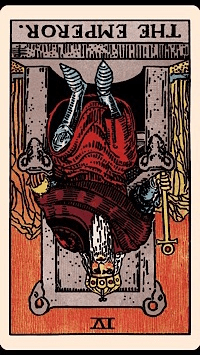
It could be that the energy shown by that card is blocked. For example, The Emperor Reversed (from here on I’ll used the standard abbreviation of Rx to refer to the reversed appearance of a card) can indicate that the leadership potential of the querent is blocked, resisted, or avoided. The cards may be signifying that you have the potential or even the destiny to be a great leader, but those qualities are not yet developed. The reversed Emperor could be suggesting that the developing the characteristics of a strong leader are the homework assignment for the querent.
The Presence of Shadow Aspects
Borrowing from the psychology of the legendary Carl Jung, it’s helpful to acknowledge that we all have “shadow” selves. According to Jung, the undesirable aspects of ourselves noticed by those around us, society at large, or even by ourselves can be repressed and banished into the “shadow” of our psyches where they can cause problems for us in our lives. The Emperor Rx, for example, can reveal leadership that is somehow corrupted or existing in the dark version of its repressed form. The Emperor Rx can represent a cruel or sadistic tyrant, for example–the shadow side of Jung’s “king” archetype.
A Warning Against
In a reading, a reversed card can offer the querent a warning, admonition against, or a cautionary note about the essence of the card. For instance, in multiple readings, I have interpreted the Ace of Swords Rx as a suggestion NOT to rely so heavily upon the intellect or reason, usually in favor of emotion or intuition. Similarly, a reversed Ace of Cups can warn a querent not to be swept away with emotion. In a very recent reading I was giving someone on the question of love, the card signifying the future of a prospective relationship was The Lovers Rx. The directness of that message was not missed on myself or the querent: “He’s not the one!” Imagine if reversals were not a possibility for the universe to offer you much needed guidance in the affirmative or negative!
Release or Relief from that Situation
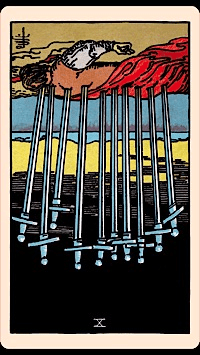
As is often the case with cards that we consider negative, a reversal can be a welcome sign! If we take, for instance, what I heard one reader describe as the worst card of the deck—The Ten of Swords—and reverse it, we can see that the swords depicted appear ready to fall out of the back of the unlucky subject in the image. That challenging, rock-bottom type of situation is still present, but in reverse: perhaps we are emerging from it into a more hopeful situation. Similarly, The Devil Rx can show release from a terrible situation, freedom re-found, or the recovery from addiction. Notice that the reversal is important in these meanings because the essential energy of the card is, in fact, present, but now being resolved. We couldn’t get the same meaning for the querent without both the presence of the card and the reversal.
The Upright Meaning But to a Lesser Degree
With two cards in particular, The Sun and The Tower, A. E. Waite, in his classic Pictorial Key to the Tarot, suggests that the powerfully positive and negative respective meanings of these two cards are merely tempered, not negated, by the reversal. In other words, The Tower Rx can indicate a minor inconvenience or impediment and The Sun Rx can indicate a modest success or under-stated victory.
You’ll notice that in each of these possible interpretations, a reversal does not necessarily indicate the opposite of a card’s given meaning, but rather a more nuanced interpretation of that meaning. You needn’t memorize additional meanings or key word for all the card, but rather just be aware of the fact that a reversal can shift the meaning of a card in one of the above possible ways (or any others that you find or develop yourself). These multiple possible interpretations offered by reversals simply enrich and deepen the vocabulary of card meanings that you can use to construct a coherent narrative for the querent.
These multiple possible interpretations offered by reversals simply enrich and deepen the vocabulary of card meanings that you can use to construct a coherent narrative for the querent.
I read reversals because I feel they give greater depth, nuance, and clarity to the reading. Just as in spoken or written language, we need negations to make certain points to each other. For example, “I don’t love you” is not the same as “I hate you.” Similarly, there is no card that upright clearly says “stifled intuition,” but The High Priestess Rx can clearly give us this meaning.
Again, you should read the cards in the way that you feel the most comfortable. I happen to be committed to my use of reversals and, if you’re open to that experience as well, I hope you’ve found my above discussion helpful and insightful.
At the very least, I hope after reading this post, you might no longer be intimidated to try reading reversals with your cards! Let me know how it goes!
Please reach out with questions or comments!
 Jesse's Journey: Reading the Tarot, Living the Life
Leave a comment